From the neon-soaked stages of Las Vegas to the record-breaking heights of 1.6 billion views, BTS has officially ushered in the ‘BTS 2.0’ era, signaling that their dominance in the music industry is not merely a memory, but an evolving, unstoppable force.
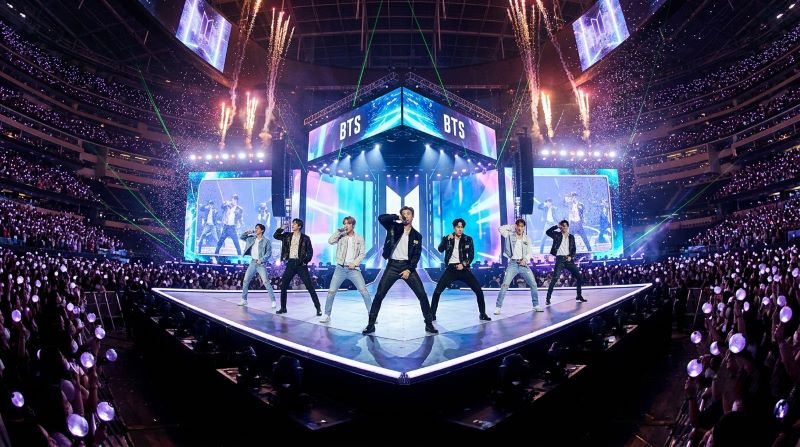
The global music landscape was electrified this past week as BTS reclaimed the stage at the 2026 iHeartRadio Music Festival in Las Vegas. After a six-year hiatus from this specific event, the group returned not as guests, but as the headline act for the finale, cementing their status as the industry’s ultimate power players. Performing a high-octane set that featured their latest track ‘SWIM’ from the fifth studio album ‘ARIRANG’, alongside ‘2.0’, ‘MIC Drop’, and ‘FYA’, the members showcased a sophisticated production aesthetic that blended high-end visual effects with their signature live intensity. This wasn’t just a comeback; it was a calibrated demonstration of a group that has moved past the need to prove themselves, shifting instead into an era of sustained, record-shattering legacy.
The Economics of ‘BTS 2.0’ and Market Dominance
To understand the magnitude of this return, one must look at the numbers. The recent reports regarding their ‘ARIRANG’ world tour are nothing short of monumental. By dominating venues like the Allegiant Stadium in Las Vegas—where they generated a staggering 49.5 million dollars in ticket sales from a single four-show run—BTS is effectively rewriting the financial benchmarks for touring artists. When you analyze the data from Billboard regarding their performance at NFL-grade stadiums, it becomes clear that they are operating in a league of their own. Achieving the highest ticket sales in venues like the Gillette and Raymond James Stadiums isn’t just about fanbase loyalty; it is a clinical display of market saturation. With total revenue figures reaching deep into the tens of millions per stadium, the group is now competing against legacy icons like George Strait and Beyoncé, not just for chart positions, but for the top tier of the global concert industry.
This financial momentum has not gone unnoticed by market analysts. Sangsangin Securities recently issued a ‘buy’ rating on HYBE, setting a target price that suggests deep investor confidence in the group’s long-term sustainability. The analysis points to the ‘ARIRANG’ tour as the primary driver of this explosive growth, with projections suggesting a massive increase in both revenue and operating profit. What this tells us as observers is that the business of BTS has transitioned from a volatile K-pop model into a stable, massive-scale global infrastructure. The inclusion of new IP like Cortis and KATSEYE into this same market analysis highlights a crucial shift: the industry is no longer asking if BTS can sustain its success, but rather how the group’s massive infrastructure will serve as the launchpad for the next generation of global artists.
Data as a Testament to Cultural Staying Power
The numbers behind their digital footprint provide a fascinating counterpoint to their live touring success. The recent milestone of ‘MIC Drop’ surpassing 1.6 billion views on YouTube is a testament to the longevity of their discography. This is their fourth music video to cross this threshold, placing them in an elite bracket of artists with sustained evergreen content. Unlike the flash-in-the-pan hits that define much of the digital streaming era, BTS content shows a ‘long tail’ phenomenon where viewership grows consistently over years rather than spiking and fading. This stability is likely what provides the bedrock for their current ability to charge premium prices for stadium tours; their audience is not just vast, it is deeply invested in the catalog.
The upcoming 2026 MTV Video Music Awards nominations further bolster this narrative. With nods in ‘Best Group’, ‘Song of Summer’, and ‘Best K-pop’, the group remains tethered to the pulse of the American awards circuit. Having already secured the ‘Best Group’ title four years in a row between 2019 and 2022, their continued presence in these categories acts as a stabilizing force in an increasingly fragmented music market. While other acts come and go, the data shows that BTS remains a fixed point of gravity. Whether it is through traditional radio metrics at iHeartRadio or the modern streaming reality of the VMA voting landscape, the group’s numbers are consistently resistant to the standard depreciation of popularity that typically plagues long-running pop acts.
Industry Evolution and the Future of the ‘BTS Standard’
Looking ahead, the pivot toward global, synchronized theater broadcasts for the South American leg of the ‘ARIRANG’ tour suggests a move toward a truly borderless consumption model. By streaming concerts across 80 countries and 3,800 screens simultaneously, the group is effectively bypassing the limitations of physical travel, creating a global ‘event’ economy around their live performances. This is a critical development for the industry: it signals that the future of K-pop isn’t just about who can sell the most albums, but about who can command the most synchronous, real-time attention across time zones.
The sentiment from the fandom, ‘ARMY’, remains the heartbeat of this trajectory. During their iHeartRadio set, the members expressed amazement at fans singing along to every Korean word—a detail that underscores how the group has successfully globalized their cultural identity rather than diluting it to fit Western markets. As we look toward the remainder of the ‘ARIRANG’ world tour, with upcoming dates in Japan and the Middle East, the clear takeaway is that ‘BTS 2.0’ is about scale. It is about taking the foundations built in the early 2020s and turning them into a permanent, high-performance ecosystem. For the rest of the industry, BTS has set a bar that is increasingly measured not just in social media engagement or chart spikes, but in the cold, hard currency of stadium capacity, sustained revenue, and multi-generational cultural impact.