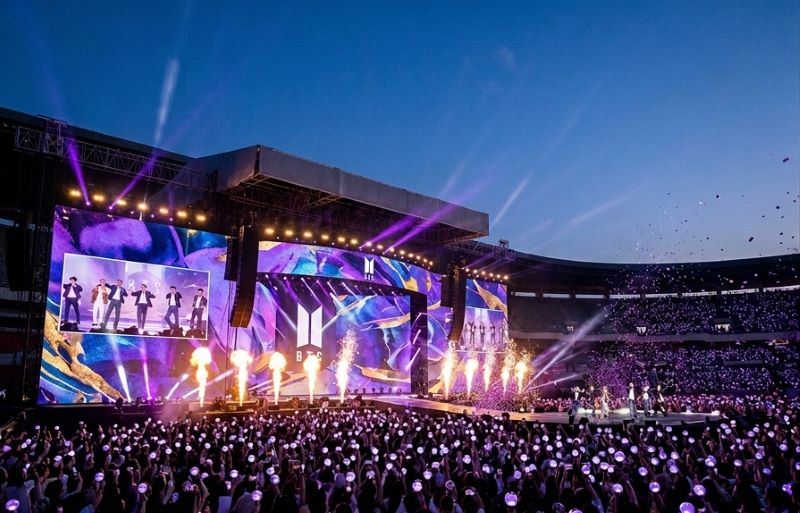
As the global music industry watches HYBE navigate a transitional era, shifting market forecasts highlight the enduring, yet evolving, influence of BTS on the agency’s long-term trajectory.
Recent financial analysis from Eugene Investment and Securities has recalibrated expectations for HYBE, citing uncertainty surrounding the group activities of BTS in the upcoming year as a primary factor for a lowered target price. While this adjustment reflects the cautious sentiment currently permeating the financial sector, it also serves as a stark reminder of the unique, symbiotic relationship between the world’s biggest boy band and the architectural powerhouse that is HYBE. For the global fan community, this news is less about the music itself and more about the structural evolution of a company that has spent the last decade diversifying its portfolio precisely to mitigate these periods of quietude.
The Evolution of a Mega-Agency
To understand the weight of this forecast, one must view it through the lens of BTS’s career arc, which has moved from the ‘underdog narrative’ of the early 2010s to a position of unprecedented global dominance. In the early years, the group was the singular engine of Big Hit Entertainment. As they broke international barriers, the company underwent a massive transformation, rebranding into HYBE—a multi-label system designed to survive the ‘post-BTS’ reality by incubating diverse talent such as SEVENTEEN, NewJeans, LE SSERAFIM, and TXT. This transition was always meant to be the company’s ultimate stress test: Can a K-pop conglomerate retain its market leadership when its primary catalyst enters a mandatory hiatus?
The current market analysis suggests that while the multi-label strategy is functional, the gravitational pull of BTS remains a distinct variable in investor confidence. This is not a failure of the newer groups, but rather an indicator of the sheer scale of the benchmark set by the seven members. When looking at the historical trajectory, BTS has survived multiple contract renewals, solo project transitions, and the shift from domestic stardom to global cultural dominance. Each milestone was met with industry skepticism, yet they consistently pivoted to higher levels of success. The current financial climate, however, introduces a new variable: the transition into a post-military service era where the industry expectation is not just a return, but a re-synchronization of seven individual solo careers back into a unified group engine.
Market Sentiment and Strategic Reality
From an analytical perspective, this downward adjustment in target price underscores the difficulty in quantifying ‘cultural capital’ against ‘quarterly earnings.’ Financial institutions favor predictability, yet the K-pop industry is inherently defined by the volatile, emotional investment of fandoms. This creates a fascinating tension; while analysts look at activity schedules and group logistics to determine stock viability, fans view the situation through a lens of artistic longevity. The uncertainty mentioned in recent reports likely stems from the complex logistical puzzle of reuniting seven of the most in-demand solo artists in the world, whose individual brands have arguably expanded significantly during their time apart.
We have seen similar patterns in the industry before, though rarely at this scale. When legacy groups transition from the ‘active release cycle’ to ‘individual pursuit’ phases, there is always a temporary softening in corporate valuation until the next major catalyst occurs. This mirrors a broader trend across K-pop where the ‘Big 4’ agencies are forced to balance the profitability of established legends with the high-cost investment of developing new IP. The ‘uncertainty’ noted by investors is not necessarily a reflection of BTS’s lack of intent to reunite, but rather a reflection of a market that is struggling to project the sheer, unpredictable magnitude of that eventual return.
Community Perspective and Future Outlook
For the average fan, these market reports are often viewed with a sense of ironic detachment. Fandoms possess an intimate knowledge of the members’ creative output and personal timelines that financial models often lack. There is a general, prevailing confidence among the global fanbase that the ‘uncertainty’ is merely a transition period, not an end. Historically, this type of news resonates with the community as a call to action or a validation of the group’s massive influence—if the company’s stock is still tethered so closely to their movements after over a decade of activity, it serves as a testament to their unrivaled legacy.
Looking ahead, the next chapter for HYBE and BTS is essentially a masterclass in risk management and legacy building. The company is actively diversifying into tech, gaming, and global collaborations to ensure that the bottom line remains robust regardless of any single artist’s activity status. However, as the industry moves toward 2025 and beyond, the focus will inevitably shift back to the group’s collective reunion. This setup creates a high-stakes environment where the quality of the ‘second act’ will define not only the future of HYBE’s valuation but the very definition of how long a K-pop act can sustain relevance. The market may be signaling a pause, but in the context of BTS’s career, pauses have historically been the prelude to their most significant, record-shattering breakthroughs.